
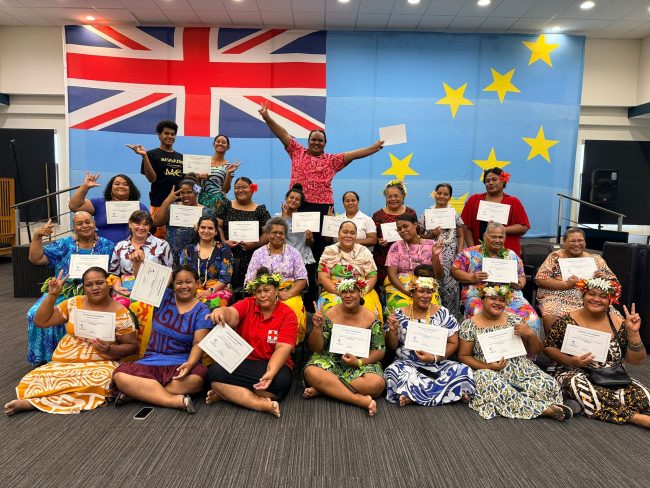
Tuvaluan participants with completion certificates after completing the DIAT in May 2026
Learning from the first two of three trainings: Disability Inclusion and Awareness Training, May 2026, and Integrated Person-Centred Health Services Workshop, September 2026
The first two trainings have shown that health systems strengthening in Tuvalu is most effective when it begins with inclusion and then connects that principle to everyday care.
The May training built a shared understanding of disability as the interaction between impairment and barriers, while further strengthening the confidence of Fusi Alofa Association and Tuvalu Red Cross’s disability inclusion advocates to facilitate and train others. We were privileged to engage Fiji’s Disabled Peoples Federation (FDPF) to lead the facilitation of the training alongside the Interplast team. This training prioritised the delivery of the curriculum by Organisations of Persons with Disabilities (OPDs) within the Pacific Region.
The September workshop extended this foundation into integrated person-centred care, bringing Fusi Alofa Association, hospital clinicians and Ministry of Health and Social Welfare staff into a common conversation about goals, referrals, handovers and continuity of care.
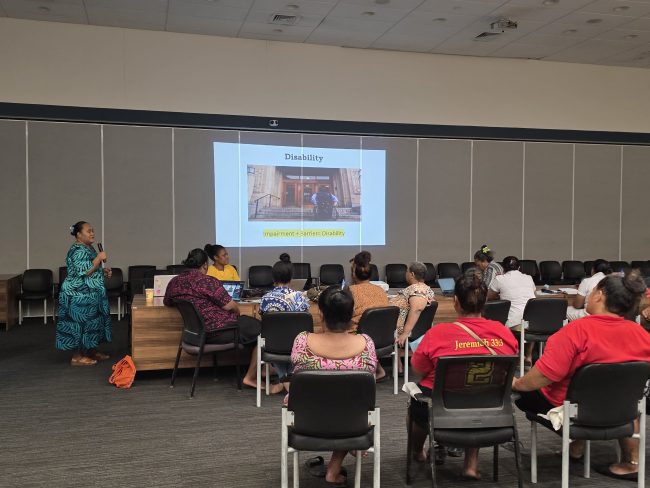
Lead facilitator from Fiji’s Disabled People’s Federation (FDPF) delivering the disability inclusion & awareness training (DIAT) in May 2026
What is beginning to change
For both trainings, the strongest learning came through participation rather than lecture: case studies, group work, drama, service mapping and role-play. These approaches enabled participants to translate broad concepts into locally meaningful action.
In May, participants moved from awareness to practical commitments such as removing barriers, communicating respectfully and involving people with disabilities in decisions.
“The most useful thing I learned in the training was how to treat persons with disabilities equally and make sure everyone feels included and respected.” – May training participant
In September, this approach became more practical: participants proposed accessible appointment systems, workplace adjustments, cross-sector referrals, improved discharge continuity and care plans centred on each person’s goals.
“The training is very important, which always remind us on how to provide integrated people centered care. Faafetai Lasi.” – September training participant
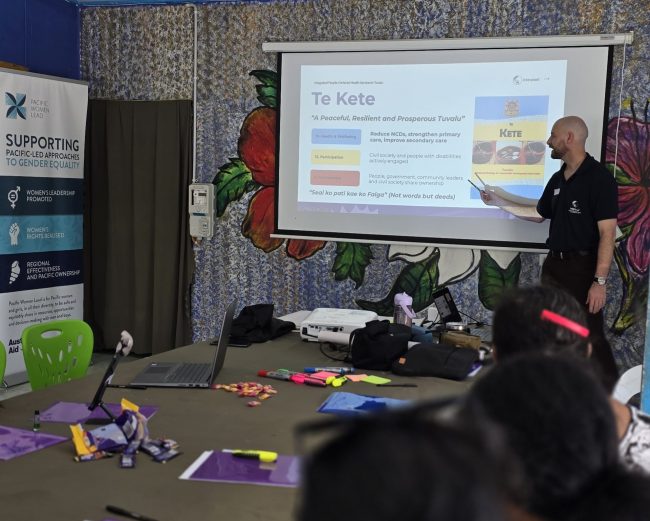
Andrew Jolly from Interplast Australia & New Zealand, delivering September training, incorporating Tuvaluan health framing from National Development Plans
The emerging systems lesson
A key reflection is that stronger services will not come from technical training alone. They depend on relationships between people with disabilities, community organisations, clinicians, public health teams and social services, supported by practical pathways and shared accountability.
The Tuvaluan framing, “Seai ko pati kae ko Faiga” (not words but deeds) captures this well. Participants are the experts in their own system; the project’s role is to create space, tools and confidence for them to identify barriers and test workable solutions.
This approach aligns with Te Kete’s (Tuvalu’s National Development Plan) emphasis on health and wellbeing, participation and partnership.
Looking towards the third visit
The third training visit in November is an opportunity to consolidate the project’s progression from awareness to shared practice, to sustained system change. Building on requests from Tuvaluan participants, practical training in diabetes-related foot disease prevention and care, prosthetics and orthotics, and accessible service delivery can provide a concrete vehicle for integrated care.
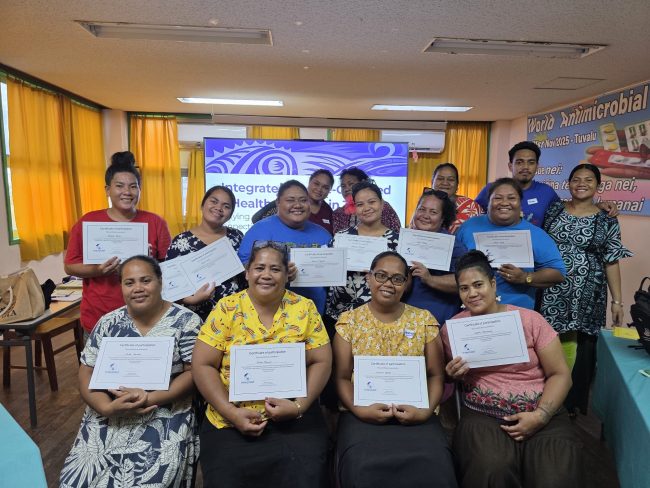
Tuvaluan public health officers receiving their completion certificates after training in September 2026
Acknowledgment
We would like to acknowledge the Tuvalu Ministry of Health and the Asian Development Bank, which engaged Interplast Australia & New Zealand as part of the broader program, “Systems Strengthening for Effective Coverage of New Vaccines in the Pacific.” Interplast’s contribution focuses specifically on strengthening gender equality and disability inclusion in microplanning, vaccine services and community awareness in Tuvalu.
Facilitators for the first two training courses:
Senimelia Bulouravuya Seru – Fiji Disabled Persons Federation (FDPF)
Emele Wabale – Fiji Disabled Persons Federation (FDPF)
Maria Waloki – Disability Inclusion Advisor – Interplast Australia & New Zealand
Andrew Jolly – AT and Rehabilitation Consultant – Interplast Australia & New Zealand
Noureen Chowdhury – Head of Integrated Care Programs – Interplast Australia & New Zealand